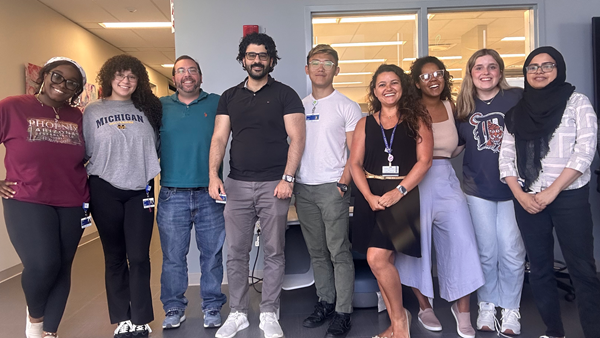
As the new school year begins, several MSU graduate students have completed their first lab rotation at Henry Ford Health in Detroit. Experiences gained during these lab rotations often influence students’ decisions about what they will pursue for their graduate studies for the next five to six years.
"I really enjoy investigating new therapies and getting hands-on experience in the lab,” said Jordan Kreger, a graduate student in the MSU BioMolecular Science Program. “I like figuring out how we can improve upon current treatments and push the boundaries of medicine to make a difference in patient care."
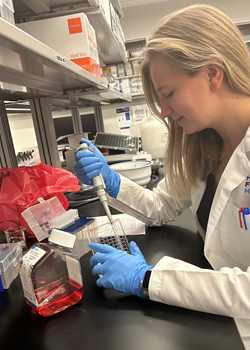
Lab rotations at Henry Ford Health are part of the new Henry Ford Health + Michigan State University Health Sciences initiative to enhance training and education opportunities for students. Over the summer, Kreger and four other MSU graduate students had the opportunity to work in Henry Ford Health research labs, with many engaging with the Henry Ford Pancreatic Cancer Center.
“Everyone was so welcoming and genuinely excited to show us what they do. This experience opened my eyes to powerful research opportunities here at Henry Ford Health,” said Raafat Chalar, who is working toward a D.O.– Ph.D. in molecular, cellular and integrative physiology from the MSU BioMolecular Science program and MSU College of Osteopathic Medicine (MSUCOM). The MSUCOM D.O.-Ph.D. Physician-Scientist Training Program is the first osteopathic medicine program to be included in the prestigious National Institutes of Health Medical Scientist Training Program.
During the eight-week rotation, the students spent their time conducting experiments and testing hypotheses related to their and the lab’s scientific interests. For Kreger, this included working alongside Ling Huang, Ph.D., studying the biological processes behind pancreatic cancer development and how a person’s genetic background may affect tumor growth.
“My experience in Dr. Huang’s lab has really helped me gain confidence,” Kreger said.
Chalar had the chance to work with Ralph Francescone, Ph.D., and Debora Barbosa Vendramini Costa, Ph.D., to better understand the tumor microenvironment and its effect on pancreatic cancer cells. Specifically, cancer associated fibroblasts derived from patients and their role in tumor growth and spread.
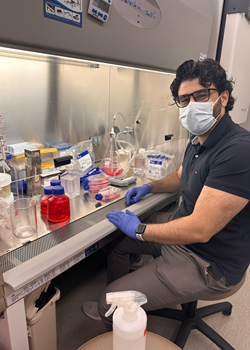
“I've never seen this amount of access to patient data and samples,” said Chalar, who took a nontraditional student path, bringing prior research experience from his master’s in physiology and biophysics at Stony Brook University. “Henry Ford Health has, I think, one of the best translational teams.”
Chalar and Kreger both agreed on the value of Henry Ford’s diverse patient population. This ultimately provides researchers with more accurate and reliable results.
“The chance to participate in this translational research is one of the biggest reasons that I chose to do a rotation at Henry Ford Health,” said Chalar. “You know you're doing something that actually might affect someone's life.”
In addition to the day-to-day lab work, the graduate students attend regular lectures, social gatherings and journal clubs, a group meeting where students read and discussed recent scientific research articles. “I’ve really enjoyed the journal clubs we’ve done as a group,” Kreger said. “They’ve given us the chance to present scientific literature, build new skills, and start thinking about research ideas ourselves rather than only carrying out a project. Coming from a technician role, that experience feels like an important step toward my career in research.”
Both Kreger and Chalar will participate in two more lab rotations at different labs in either MSU or Henry Ford before committing to a lab where they will complete their graduate program.
Kreger is excited to explore other labs but shared that this lab rotation at Henry Ford Health has solidified her desire to pursue translational research long-term.
Chalar, who is exploring the possibility of joining a Henry Ford Health lab after rotations, reflected on the decision-making process: “You're going to be working with these people for a long time. The science can be exciting, but the right mentor and environment can make all the difference.”