Christopher Dabish fondly remembers attending a Fuel Up to Play 60 event at Ford Field when he was in elementary school. Now, the Michigan State University College of Human Medicine fourth-year medical student returns to the stadium as one of the medical students selected to participate in the 2026 NFL Sports Medicine Pipeline Program. The competitive program provides medical students with hands-on exposure to sports medicine and player care in a professional football setting.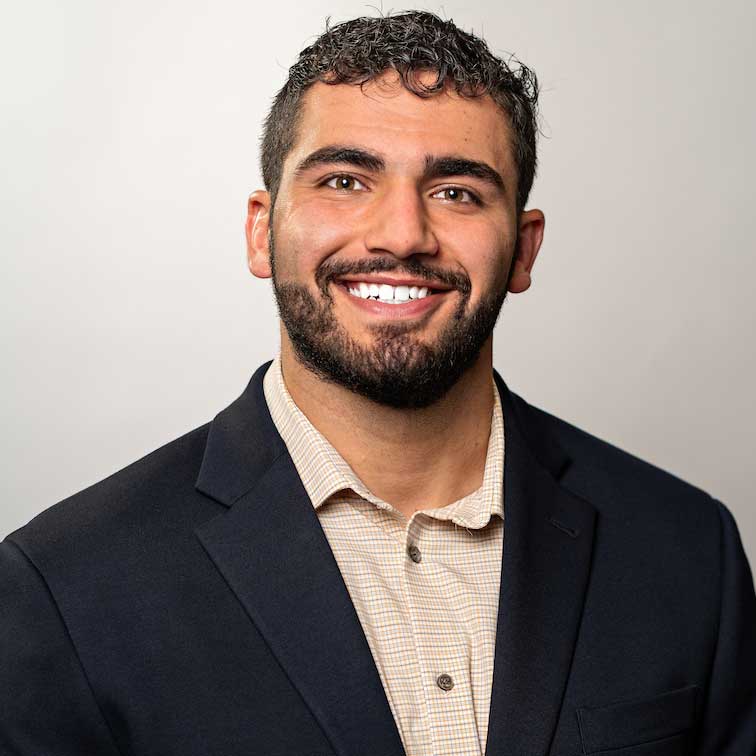
“When I learned I was selected for the program, I felt incredibly blessed and grateful for the opportunity,” said Dabish, a Chaldean American who hopes his participation will show younger students from his community that opportunities like this are possible.
Dabish will complete a monthlong clinical rotation with the Detroit Lions through Henry Ford Health, the team's official physicians. During the rotation, he will work alongside primary care sports medicine specialists, orthopedic sports medicine surgeons, athletic trainers and other members of the sports medicine team.
“I know this is a truly unique experience, and it’s rare for something like this to align so closely with both your goals and your passions,” said Dabish. “I wouldn’t want to spend this month anywhere else.”
A lifelong athlete, Dabish spent a decade playing tackle football while also competing in swimming and track before pursuing Brazilian jiu-jitsu during medical school. He hopes to use the program to further explore his interest in Family Medicine with plans to pursue a Sports Medicine Fellowship.
“Similar to how Family Medicine is known for its breadth, that’s how I’m approaching this opportunity as well,” said Dabish. “My plan is to be a sponge over the next month and absorb as much as I can.”
As the Detroit Lions’ voting team physician and a Henry Ford Health emergency medicine and sports medicine physician, Bradley Jaskulka, M.D., will provide mentorship and guidance throughout Dabish’s month with the team. Under Jaskulka’s mentorship, Dabish will gain firsthand exposure to caring for elite athletes while developing an understanding of the interdisciplinary collaboration, leadership and communication skills that are essential to sports medicine.
“Christopher has shown dedication to the field of sports medicine,” said Jaskulka. “He combines firsthand athletic experience [with] more than 240 hours of sideline and ringside coverage across boxing, MMA, hockey, wrestling, and football at high school through professional levels.”
The NFL Sports Medicine Pipeline Program reflects Henry Ford Health + Michigan State University Health Sciences’ commitment to providing learners with innovative, hands-on training that connects academic medicine, clinical practice and real-world patient care.
As Dabish said, “I know the habits and skills I develop will stay with me, and I look forward to bringing this experience back to the communities I serve and sharing it with my future colleagues.”